

Building Your First Pedalboard: What You Actually Need (and What You Don't)
A no-nonsense guide to building your first guitar pedalboard — what actually matters for tone and reliability, and which "essential" gear you can skip at the start.
Every pedalboard forum thread eventually turns into a flex — twelve boutique pedals, a power supply the size of a toaster, cables that cost more than the guitar. None of that is where you should start. Here's what a first pedalboard actually needs, and what you can safely ignore until you know what you're missing.
Start with the question, not the gear
Before buying anything, answer this: are you trying to shape one core tone, or explore a lot of different sounds?
-
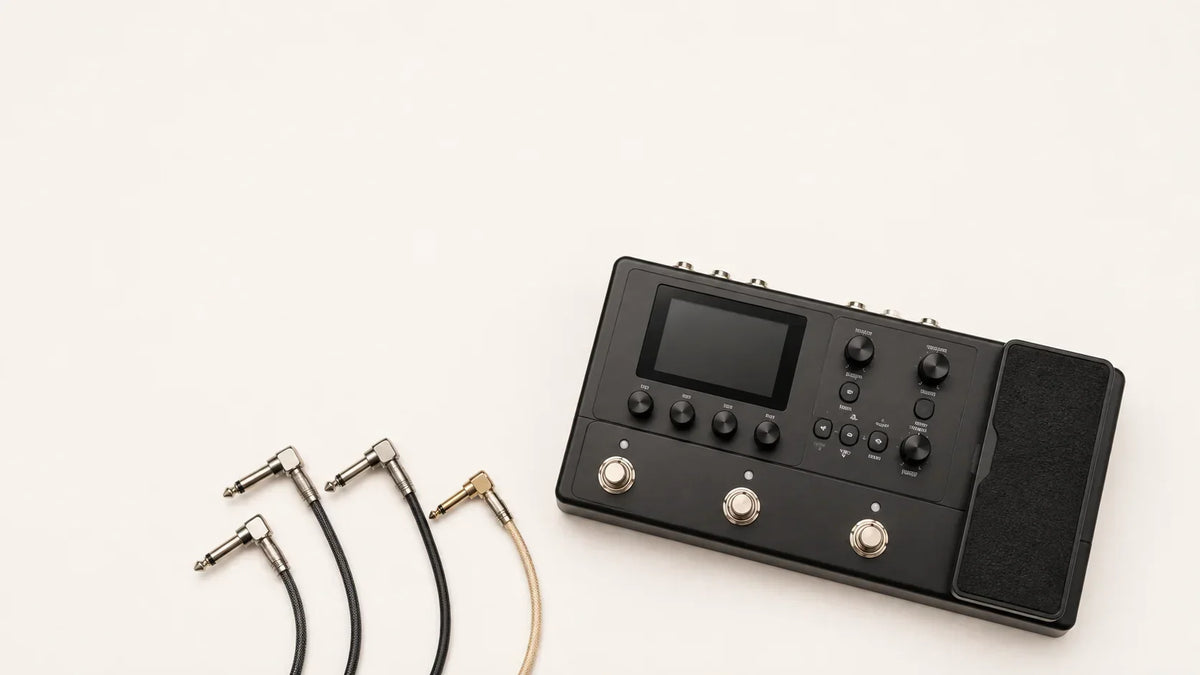
If you play mostly one style and want a reliable, dialed-in tone — a single multi-effects processor (like a compact Hotone or Valeton unit) gets you there in one box, at one price, with far less to go wrong.
-
If you want to experiment across genres, or you like the hands-on ritual of tweaking individual pedals — a small pedal chain of 3-4 individual stompboxes is the better long-term investment.
Most beginners are better served by option one. It's not a compromise — it's the more disciplined choice, and you can always branch into individual pedals later once you know exactly what tone you're chasing.
The 4 things a first setup actually needs
-
The sound-shaping unit itself — a multi-FX processor or a small, focused pedal chain (drive → modulation → delay/reverb is the classic, safe order if you're going the individual-pedal route).
-
Correct cables — an instrument cable from guitar to unit, one from unit to amp, and short patch cables if you're chaining multiple pedals. This is the single most common thing beginners under-budget for, and cheap or damaged cables cause more "why does my tone sound bad" complaints than the pedals themselves.
-
Reliable power — whatever your unit needs (check the spec, don't guess), consistent power. Nothing kills tone and patience faster than a cheap power supply introducing hum.
-
Something to keep it all in place — even a basic board or case, once you're past the single-unit stage, prevents cables from working loose mid-set.
What you don't need on day one
-
A dedicated tuner pedal, if your amp or processor already has a built-in tuner
-
A boutique/premium cable set — a solid mid-range cable is genuinely fine to start; the return on spending 5x more shows up later, not on day one
-
Every effect type "just in case" — a processor with 50+ onboard effects is a feature, not a requirement to use all 50
-
A full-size board, if you're running one unit — that's solving a problem you don't have yet
Multi-FX vs. individual pedals — the honest tradeoff
Neither is "better" — they solve different problems. If you're not sure, the processor is the lower-risk starting point, and nothing stops you from adding individual pedals around it once you know what's missing from your sound.
A simple starting shopping list
-
1 multi-FX processor or 3 individual pedals (drive, modulation, delay)
-
2 instrument cables (guitar→unit, unit→amp) + patch cables if chaining pedals
-
Power supply matched to your unit's spec
-
A basic board or case once you're running more than one piece of gear
The gear that looks impressive on a pedalboard forum isn't what makes you sound better. Cables that don't cut out, power that doesn't hum, and one unit you actually understand will get you further than a wall of boxes you're still learning to use.